CTET 2011 Question Paper-2 with Answer | ||||
| Child Development | Mathematics and Science | Social studies | Language-I(Eng) | Language-II(Hindi) |
Q51. The above represents the work of a student. If this error pattern continues, the students answer to 5/11 – 2/7 will be
(a) 7/18
(b) 3/4
(c) 3/7
(d) 2/18
Q52. A teacher in Grade VI provided each child with a centimeter grid paper and a pair of scissors. She wanted them to explore how two-dimensional shapes can be folded into three-dimensional objects. Which of the following concepts are the students exploring?
(a) Rotation
(b) Reflection
(c) Nets
(d) Decimals
Q53. When doing exponents, the work observed in a learner’s notebook was as follows:
43 x 42 = 45
64 x 64 = 68
73 x 37 = 2110
The learner has not understood how to
(a) add exponents
(b) add exponents and multiply
(c) multiply numbers with the same base
(d) multiply numbers with different bases
Q54. Teachers, while discussing problem-solving as an approach to the teaching of mathematics, articulated four views. Which of the following views does not justify the real meaning of this approach?
(a) I think questions on problem-solving should be made from situations based on real-life.’
(b) I think many questions found in the mathematics textbook can be used for problem-solving
(c) I think it is better to connect problem-solving with general mathematics class.
(d) I think there is no correlation between problem- solving and mathematical reasoning’
Q55. Given linear equations, I, II and III, a learner is not able to solve II algebraically. The most likely area of difficulty Is that the learner has not understood

(a) that two equations can be added or subtracted to Solve them
(b) that two equations can be solved by the method of substitution
(c) the method of solving equations using graphs
(d) that both the equations can be altered by multiplying with suitable numbers
Q56. When introducing menstruation, a teacher writes all the formulae on the board before proceeding further. This reflects that she is following the
(a) inductive approach
(b) deductive approach
(c) experimental approach
(d) practical approach
Q57. Ameena is playing with matchsticks and adds one

Appu, on the other hand, makes a table:
| Number of L’s | 1 | 2 | 3 | ……. |
| Number of matchsticks | 2 | 4 | 6 | ……. |
What is your observation of two children in this situation?
(a) Ameena is only playing and Appu is doing mathematics.
(b) Ameena will need lots of matchsticks to come to a generalization. However, Appu would be a taster.
(c) Both Ameena and Appu are trying to make generalizations.
(d) Ameena would be learning by doing and Appu may not be able to see the pattern at al
Q58. To be good in mathematics, one needs to
(a) remember solutions
(b) have mastery over calculations
(c) create and formulate problems through abstract thinking and logical reasoning
(d) memorize formulae
Q59. Students make errors while solving mathematical problems because
(a) they do not practice enough
(b) they do not refer to multiple textbooks
(c) their Socio-economic status affects their performance
(d) they make alternative interpretations of concepts in their attempt to device meaning
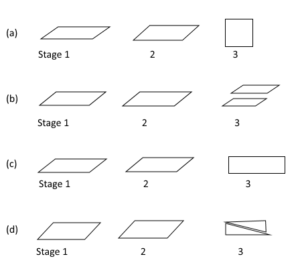
Q60. With activity on paper folding, a teacher was trying to depict the relationship of the areas of a parallelogram and a triangle. Which of the following best depicts the transformation of stages?