

| CTET January 2012 Question Paper-2 with Answer | ||||
| Child Development | Math and Science | Social Science | Language-I (Eng) | Language-II (Hindi) |
Candidate have to do questions number 31 to 90 either from Part-II ( Mathematics and Science ) or from Part-III ( Social Studies/ Social Science):
Part-III: Social Science
Directions: Answer the following questions by selecting the most appropriate option.
Q31. Which of the following combinations of kingdoms was engaged in tripartite struggle?
(a) Pala, Chola, Gurjar-Pratihara
(b) Chola, Rashtrakuta, Pala
(c)Pala, Pallava, Rashtrakuta
(d) Rashtrakuta, Pala, Gurjar-Pratihara
Q32. Who of the following was impeached by the British Parliament?
(a) Cornwallis
(b) Charles Clive
(c) Warren Hastings
(d) T.B. Macaulay
Q33. Which of the following three universities were established in the year 1857 by the British Government?
(a) Calcutta, Bombay and Delhi
(b) Calcutta, Madras and Bombay
(c) Calcutta, Madras and Banaras
(d) Calcutta, Bombay and Panjab
Q34. Chera chieftains ruled in twelfth century in the area presently lying in
(a) Punjab/Haryana
(b) Chhattisgarh/ Madhya Pradesh
(c) Jharkhand/ Bihar
(d) Uttrakhand /Uttar Pradesh
Q35. Which one of the following Sultans used the Banjaras to transport grains to the city markets?
(a) Alauddin Khilji
(b) Balban
(c) Firoz-Shah Tughlaq
(d) Muhammad-Bin-Tughlag
Q36. Bidri was
(a) a type of copperware produced in Bidar
(b) an inlay work in copper and silver done by the artisans of Bidar
(c) a type of silk textile produced in Bidar
(d) a type of cotton textile produced in Bidar
Q37. Tribal people do not keep written records of their past. How do present-day historians write tribal history?
(a) Using tribal mythologies
(b) Using archaeological sources
(c) Using oral traditions
(d) Using natural traditions
Q38. Pietra dura was a
(a) Metallurgy technology
(b) Style of decoration of buildings
(c) Role of succession
(d) Greek god
Q39. Which of the following was a part of temple architecture of the ninth century?
(a) Rangshala (place to perform dance)
(b) Yagya Vedi (Seat to perform sacred incantation)
(c) Havan Kund (square pyramid shaped pot with open mouth to hold fire)
(d) Decorative gateway (Dwara)
Q40. In nuclear power plants, electricity is generated through the process of
(a) atomic vibrations
(b) nuclear fusion
(c) nuclear fission
(d) nuclear collision
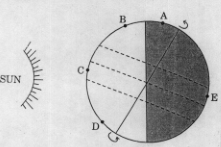
Q41. The following diagram shows the position of the Earth on a particular day. A,B,CD and E are locations on the Earth. Which location will experience longest hours of daylight
(a) D
(b) A
(c) B
(d) C
Q42. Tanti, Momin, and Devangs communities were engaged in
(a) Pottery making
(b) Leatherworks
(c) Weaving
(d) Woodworks
Q43. Muhammad-Bin-Tughlaq shifted his capital from Delhi to Daulatabad
(a) as he was not getting enough revenue from North India
(b) to escape from Mongols
(c) to punish Southern rulers
(d) to control his empire effectively as Daulatabad was centrally located
Q44. As a consequence of the Revolt of 1857, which of the following was a change initiated by the British Parliament?
(a) The land and property of prominent Hindu and Muslim citizens who supported the revolt were confiscated
(b) Pathan and Sikh soldiers were banned from joining the British Indian Army
(c) All ruling chiefs of the country were warned that military action would be taken against them if they support any rebellion
(d) A member of the British Cabinet was appointed Secretary of State for India
Q45. In 1720, the British Government enacted legislation called the Calica Act to
(a) produce Calico textiles in England
(b) ban the use of printed cotton textiles Chintz in England
(c) punish rebels from Calicut
(d) promote Calico industry in England
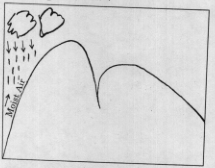
Q46. which type of rainfall is represented in the diagram given below?
(a) Frontal rainfall
(b) Cyclonic rainfall
(c) Orographic rainfall
(d) Convectional rainfall
Q47. Wind actions create “Mushroom rocks’ which are usually found in
(a) Tropical coastal areas
(b) Hills
(c) Plateaus
(d) Deserts
Q48. Vultures in the Indian subcontinent started dying of kidney failure shortly after scavenging livestock treated with
(a) Aldrin
(b) Diclofenac
(c) Aspirin
(d) Ibuprofen
Q49. If Ahmadabad is situated on 72°30′ E longitude, what would be the local time of Ahmadabad if it is 8:00 am Indian Standard Time?
(a) 7:00 am
(b) 8:40 am
(c) 8:00 am
(d) 7:20 am
Q50. ‘Blackfoot Indian’ is a
(a) migrant Indian in Canada
(b) disease prevalent in the Nicobar Islands
(c) native tribe of North America
(d) plantation worker in Cuba
Q51. Ahmadabad is a hub of the cotton textile industry. Which of the following is one of the factors for flourishing textile industries in Ahmadabad?
(a) Availability of cheap labor-force
(b) It is situated close to the cotton-growing area
(c) Its easy access to the Tuticorin Port
(d) Industrial Policy of the Indian Government
Q52. A historical site is a place where
(a) excavation activities are done
(b) history-loving people gather
(c) historians write history
(d) relics of the past are found
Q53. Which of the following combinations planets is known as gaseous planets”?
(a) Jupiter, Mars, Earth, Neptune
(b) Venus, Jupiter, Mars, Saturn
(c) Mars, Venus, Saturn, Uranus
(d) Jupiter, Saturn, Uranus, Neptune
Q54. What is ‘Common Era’
(a) A new Era developed by the amalgamation of Hindu Era and Islamic Era
(b) A new era to study historical events
(c) Christian Era which is now accepted in major parts of the world
(d) Indian Era accepted by the government to issue notices
Q55. The East India Company used the Diwani revenue from Bengal primarily in
(a) building schools, colleges, and universities
(b) purchasing cotton and silk textiles in lndia
(c) amassing stocks of gold and silver to replenish the dwindling stocks in Britain
(d) constructing bridges and roads
Q56. Which of the following tribal societies was divided into khels?
(a) Bhil
(b) Gond
(c) Ahom
(d) Santhal
Q57. Plantations, a type of commercial farming. require a large amount of
(a) only capital
(b) land and labor
(c) labor and capital
(d) land and capital
Q58. The division of the period of Indian History into “Ancient’, of the period of Indian History into ‘Ancient, ‘Medieval, and Modern’ also has problems. Which of the following is one of the problems in it?
(a) Three periods are insufficient to describe Indian History
(b) The concept has been borrowed from the West where Modern period was associated with science, reason, democracy, liberty, and equality
(c) Indian History seems to have clear lines of distinction between “Ancient’, and ‘Medieval, and “Medieval” and ‘Modern'”, period
(d) The tripartite division reflects gradual growth of the Indian State
Q59. The East India Company set up a factory in Bengal on the banks of Hugli in 1651 to
(a) establish a base from which the factors could operate
(b) manufacture cotton textiles for exporting to England
(c) buy spices for sending them to England
(d) buy Indigo (Neel) from local farmers to send it to England
Q60. Why did Jatis emerge within Varnmas, which became the basis to organize Indian society?
(a) Jatis and Varnas are one and the same
(b) Fierce opposition against the Varna system gave way to the development of Jatis
(c) Due to gradual expansion in the social and economic needs of the people, people with new skill-sets were required
(d) There was a problem in integrating tribal people into Varna system
Q61. The question-answer technique can be quite effective in teaching Social Science as it ensures
(a) students come into class well-prepared
(b) amore disciplined class
(c) active participation by learners
(d) students’ ability to respond better in examination
Q62. A teacher while explaining agricultural practices discusses case studies on agricultural practices in India and the USA.
Which aspect of learning is she/he focusing on?
(a) Ability to learn by comparing and contrasting through concrete examples
(b) Ability to understand the concept
(c) Ability to interpret and explain
(d) Ability to make a better project
Q63. Media is no longer considered independent because of its close links with
(a) Civil society
(b) Government agencies
(c) Business houses
(d) NGO
Q64. The Government of India appointed a committee headed by Justice Rajinder Sachar to examine the social, economic and educational status of which of the following communities?
(a) Muslim
(b) Jain
(c) Sikh
(d) Anglo-Indian
Q65. In order to promote the process of cooperative learning, the teacher should
(a) allot individual assignment to each student
(b) assign group projects
(c) engage students in debate and discussions
(d) divide the class into groups of homogeneous ability
Q66. One of the most important and effective methods of teaching History at elementary level is
(a) Story-telling method
(b) Lecture method
(c) Discussion method
(d) Question-answer method
Q67. Showcasing adivasis as wearing colorful costumes, headgear and dancing often results in
(a) discriminating against such groups
(b) promoting adivasi culture
(c) demonstrating the diversity of Indian culture
(d) attracting attention of the world to the plight of poor adivasis
Q68. According to the Indian Constitution, the right empowering citizens to move to High Court or Supreme Court if they believe that any of their Fundamental Rights has been violated by the State, is
(a) Right to constitutional remedies
(b) Right against exploitation
(c) Right to equality
(d) Right to life
Q69. While teaching the concept of ‘Weather and Climate’, what would be the most appropriate activity to make students understand the various elements of weather?
(a) Write answers to the questions related to weather in the not book
(b) Solve the worksheet provided by the teacher based on the elements of weather
(c) Collect the weather report of five consecutive days from the newspaper and stick in their notebooks
(d) Ask them to draw the symbols of elements of weather
Q70. In teaching of Social Sciences, the emotions of most easily aroused not by words but by sights and sounds, or which the most effective way of teaching is through
(a) Classroom discussions
(b) Project method
(c) Lecture method
(d) Field trips and surveys
Q71. While teaching “Poverty,’ which strategy would be most appropriate?
(a) Ask students to read from the textbook and explain the difficult words
(b) Prepare notes and deliver and good lecture
(c) Give hand-outs to students and explain
(d) Engage students in debate and discussions
Q72. ‘Team Teaching’
(a) is a way out to manage with the shortage of teachers
(b) encourages healthy competition among teams of teachers in a school
(c) involves small teams of students as per their ability
(d) involves teams of teachers to optimize resources, interest and expertise
Q73. The National Curriculum Framework 2005, suggests that instead of Civics’ the term Political Science’ be used because
(a) Political Science’ will provide political training
(b) The term “Civics was coined in the Raj era and is associated with obedience and loyalty
(c) Political Science’ is taught at a higher level of education, therefore schools should prepare grounds for it
(d) Political Science’ is a globally recognized field of study
Q74. While dealing with ‘Social Equality’, what should be the most appropriate approach for teaching?
(a) Explaining in detail the practice of untouchability
(b) Explaining the concept as described in the textbook
(c) Giving a project to students to review texts relating to Social Equality
(d) Citing the experiences of the communities that make up the social and cultural milieu of the child
Q75. Cultural, social and class differences generate their own biases and prejudices in the contexts of classrooms. The approach to teaching therefore needs to be
(a) Project-oriented
(b) Discussion-oriented
(c) Open-ended
(d) Lecture method
Q76. While teaching an issue sensitive to a particular community but described in the textbook,
(a) the teacher should ask students to make notes on these in the library or at home
(b) the teacher should respect the textbook and explain the facts as given
(c) the teacher should write to the authorities to omit the contentious topic from the curriculum
(d) the teacher should explain the concept with sensitivity and firm commitment while respecting the dignity of students
Q77. The first hour of every sitting of the Lok Sabha is called
(a) Privilege hour
(b) Zero hour
(c) Question hour
(d) Public hour
Q78. All Indians should have a right to vote irrespective of their socio-economic status. This idea can be associated with
(a) Dr. Rajendra Prasad
(b) BR Ambedkar
(c) Jawaharlal Nehru
(d) Mahatma Gandhi
Q79. In order to promote interactive environment in a Social Science class, which of the following approaches would be most suitable?
(a) Showing documentaries
(b) Dictation and practice
(c) Frequent testing
(d) Lecture and explanation
Q80. Which amongst the following is associated with oral reasoning
(a) Narrating an algorithm
(b) Imitating peers
(c) Writing an article by pronouncing words loudly
(d) Impromptu application and extrapolation of concepts
Q81. Public Interest Litigation (PIL) has
(a) hampered government functioning
(b) increased access to justice
(c) hampered the delivery of justice
(d) led to a decrease in judicial activism
Q82. ‘Right to Education’ is a fundamental Right under Article 21 which deals with ‘Right to Life’ because
(a) only an educated person has right to life
(b) education is life
(c) not all people had right to education
(d) education helps in leading a dignified life
Q83 ‘Child-centered’ pedagogy is
(a) to teach children in small child care centers to ensure individual attention
(b) teaching as per the desire of a child
(c) teacher explains the concept by standing in the centre with children encircling her
(d) giving primacy to children’s experiences, their voices, and their active participation
Q84. The major purpose of assessment in Social Science should be to
(a) predict the learners’ chances of pursuing a successful career in humanities
(b) gauge the extent of the knowledge of content acquired by learners
(c) maintain a desirable academic quality of knowledge in the students passing out
(d) provide credible feedback on the extent to which educational objectives have been achieved
Q85. The book ‘Social and Political Life-Il’ advocates which of the following forms of evaluation, among other forms?
(a) Written mode of examination
(b) Open book exercises
(c) Personal interviews
(d) IT (computer) enabled evaluation
Q86. ‘Learning Without Burden (1993)’ recommended that learning in Social Sciences should
(a) continue to follow the epistemological framework of High lighting developmental issues
(b) help in the retention of important information
(c) promote developing concepts and abilities to analyze socio-political realities
(d) develop skills relevant to jobs
Q87. A trainee teacher writes one of the instructional objectives as ‘students shall be able to describe the meaning democracy’. In which domain shall this objective fall?
(a) Skill
(b) Synthesis
(c) Comprehension
(d) Analysis
Q88. Social and Political Life’ textbooks use which of the following methods to contextualize education to a child’s world?
(a) They incorporate lesser number of pictures to avoid distracters
(b) They astutely intermingle the social and political lives of Indian people
(c) They use a lot of case studies and narratives in a mix of rural and urban examples
(d) They cite results of many surveys done in this reference
Q89. ‘Putting out system’ is
(a) whereby merchants supply raw material and receive finished product
(b) whereby merchants sell their merchandise on installments
(c) whereby merchants force laborers to work for extra hours
(d) whereby merchants give advances and receive the pro duct
Q90 C.K. Janu is a very eminent
(a) Anthropologist
(b) Adivasi activist
(c) Environmentalist
(d) Script writer