A = $\frac{\mathrm{k}}{2}$ ; B =$\frac{\mathrm{k}}{3}$; C = $\frac{\mathrm{k}}{4}$
A : B : C = $\frac{\mathrm{k}}{2}:\frac{\mathrm{k}}{3}:\frac{\mathrm{k}}{4}=12:8:6=6:4:3$
Using Trick:
A : B : C = $\frac{1}{2}:\frac{1}{3}:\frac{1}{4}=6:4:3$
Trick: If xA = yB = zC, then find A : B : C = $\frac{1}{\mathrm{x}}:\frac{1}{\mathrm{y}}:\frac{1}{\mathrm{z}}$
Q12. The total number of students in a school is 8670. If the number of boys in the school is 4545, then what will be the ratio of the total number of boys to the total number of girls in the school?
(a) 303 : 275
(b) 275 : 303
(c) 11 : 12
(d) 12 : 11
(e) None of the above
Answer: (a) 303 : 275
Solution: Total number of student = 8670
Boys = 4545
∴ Girls = 8670 – 4545 = 4125
Ratio of the total number of boys to the total number of girls in the school = 4545:4125 = 303:275
Q13. In a class, the number of boys and girls is in the ratio of 4 : 5. If 10 more boys join the class, the ratio of numbers of boys and girls becomes 6 : 5. How many girls are there in the class?
Q15. 465 coins consists of 1 rupee, 50 paisa and 25 paisa coins. Their values are in the ratio 5: 3 : 1. The number of each type of coins respectively is
(a) 155, 186, 124
(b) 154, 187, 124
(c) 154, 185, 126
(d) 150, 140, 175
Answer: (a) 155, 186, 124
Solution:
Ration of the coins = 5 : 6 : 4
Number of 1 rupee coin = $465\times \frac{5}{15}=155$
Number of 50 paisa coin = $465\times \frac{6}{15}=186$
Number of 25 paisa coin = $465\times \frac{4}{15}=124$
Rules: x coins consists of 1 rupee, 50 paisa and 25 paisa coins. Their values are in the ratio a:b:c. The number of each type of coins respectively is
First we convert ratio from values to number
Ratio of the coins = a : 2b : 4c
Number of 1 rupee coin = $\mathrm{x}\times \frac{\mathrm{a}}{\mathrm{a}+2\mathrm{b}+4\mathrm{c}}$
Number of 50 paisa coin = $\mathrm{x}\times \frac{2\mathrm{b}}{\mathrm{a}+2\mathrm{b}+4\mathrm{c}}$
Number of 25 paisa coin =$\mathrm{x}\times \frac{4\mathrm{c}}{\mathrm{a}+2\mathrm{b}+4\mathrm{c}}$
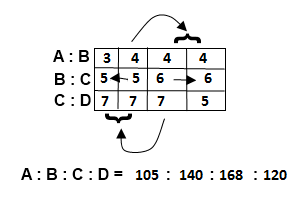
Q16. If a : b = 2 : 3, b : c = 3 : 4, c : d = 4 : 5, find a : b : c : d.
(a) 5 : 4 : 3 : 2
(b) 30 : 20 : 15 : 12
(c) 2 : 3 : 4 : 6
(d) 2 : 3 : 4 : 5
Answer: (d) 2 : 3 : 4 : 5
Solution: a : b : c : d = 2 : 3 : 4 : 5
Trick: If A:B = m : n, B:C = n : o and C : D = o : p then A:B:C :D= m : n : o : q
Q17. Divide Rs. 671 among A, B, C such that if their shares be increased by Rs. 3, Rs. 7 and Rs. 9 respectively, the remainder shall be in the ratio 1 : 2 : 3.
(a) Rs. 112, Rs. 223, Rs. 336
(b) Rs. 114, Rs. 221, Rs. 336
(c) Rs. 112, Rs. 227, Rs. 332
(d) Rs. 114, Rs. 223, Rs. 334
Answer: (a) Rs. 112, Rs. 223, Rs. 336
Solution: Let A’s share be Rs. x, B’s share be Rs. y. Then, C’s share = Rs. [671 – (x + y)]
Now, x + 3 : y + 7 : 671 – (x + y) + 9 = 1: 2 : 3
x + 3 : y + 7 : 680 – (x + y) = 1: 2 : 3
⇒ x + 3 = $\frac{1}{6}\times 690=115$ or x = 112
⇒ y + 7 = $\frac{2}{6}\times 690=230$ = or y = 223
Q19. The income of A and B are in the ratio 3 : 2 and expenses are in the ratio 5 : 3. If both save Rs. 200, what is the income of A?
(a) Rs. 1000
(b) Rs. 1200
(c) Rs. 1500
(d) Rs. 1800
Answer: (b) Rs. 1200
Solution: Let income of A = Rs. 3m, income of B = Rs. 2m and expenditure of A = Rs. 5p, expenditure of B = Rs. 3p
Now, saving = income – expenditure
∴ 3m – 5p = 2m – 3p = 200
⇒ m = 2p and p = 200
∴ m = 400
∴ A’s income = Rs. 1200
Using Trick: Monthly income of A = $\frac{200\times 3\left( 3-5 \right)}{3\times 3-2\times 5}=1200$
Q20. A and B are two alloys of gold and copper prepared by mixing metals in the ratio 7 : 2 and 7 : 11 respectively. If equal quantities of the alloys are melted to form a third alloy C, the ratio of gold and copper in C will be:
(a) 5 : 7
(b) 5 : 9
(c) 7 : 5
(d) 9 : 5
Answer: (c) 7 : 5
Solution: Gold in C in one unit = $\left( \frac{7}{9}+\frac{7}{18} \right) \,\,=\frac{7}{6}$
Copper in C in one unit = $\left( \frac{2}{9}+\frac{11}{18} \right) \,\,=\frac{5}{6}$
Ratio of gold and copper in C = $\frac{7}{6}:\frac{5}{6}=7:5$