
World Geography MCQ Questions and Answer | ||||
| Quiz-1 | Quiz-2 | Quiz-3 | Quiz-4 | Quiz-5 |
| Quiz-6 | Quiz-7 | Quiz-8 | Quiz-9 | Quiz-10 |
| Quiz-11 | Quiz-12 | Quiz-13 | Quiz-14 | Quiz-15 |
Q51. “From Aceh in the far northwest to Torres Strait in the east is 5000 miles, almost as far as from London to Baghdad. The archipelago has 14,000 islands, some mere equatorial rocks, others some of the largest in the world.” This description best fits:
(a) West Indies
(b) Japan
(c) the Philippines
(d) Indonesia
Q52. Which continent of the world does not have a desert?
(a) Australia
(b) Europe
(c) Asia
(d) North America
Q53. One astronomical unit is the average distance between which of the following?
(a) Earth and Sun
(b) Earth and Moon
(c) Jupiter and Sun
(d) Pluto and Sun
Q54. Daily weather map showing isobars is an example of:
(a) Choropleth map
(b) Isopleth map
(c) Chorochromatic map
(d) Choroschematic map
Q55. International Date Line is
(a) equator
(b) 0° longitude
(c) 90° east longitude
(d) 180° east-west longitude
Q56. The number of satellites of mercury is/are-
(a) 0
(b) 1
(c) 2
(d) 16
Q57. Consider the geographical details given in the following figure:
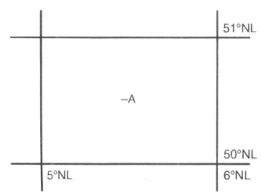
The point marked by A in the above figure indicates the countries in:
(a) North America
(b) South America
(c) Europe
(d) Asia
Q58. Asia has large areas of inland drainage. Why is it so
(a) Rainfall is seasonal and scanty
(b) There are a number of intermountain plateaus
(c) River channels are obstructed by lava flows
(d) It is a very large continent
Q59. Which of the following scientist had proven that every planet has an elongated path?
(a) Galileo
(b) Newton
(c) Copernicus
(d) Kepler
Q60. “…..They are people of yellow complexion, oblique eyes, high cheekbones, sparse hair, and medium height.”
The reference here is to:
(a) Nordic Aryans
(b) Austria
(c) Negroids
(d) Mongoloids
Q61. Given below are two statements, one labelled as Assertion (A) and the other labelled as Reason (R). Select your answer from the codes given below–
Assertion (A): Maps that are usually referring to various attributes information are called complex thematic maps.
Reason (R): Complex Thematic Maps are used to show locations of the earth’s different features and activities.
Codes:
(a) Both (A) and (R) are true and (R) is the correctexplanation of (A)
(b) Both (A) and (R) are true, but (R) is not the correct explanation of (A)
(c) (A) is true, but (R) is false
(d) (A) is false, but (R) is true
Q62. Why do stars look more in the west than the east?
(a) Universe is moving from east to west
(b) Earth is moving around the Sun
(c) Earth is moving from east to west
(d) Earth is moving from west to east
Q63. During a flight from Delhi to Tokyo, the following are the landing airport.
- Hong Kong
- Hanoi
- Taipei
- Bangkok
(a) 1, 2, 3, 4
(b) 4, 2, 1, 3
(c) 2, 4, 3, 1
(d) 3, 2, 1, 4
Q64. The equatorial circumference of the Earth is near—
(a) 31,000 km
(b) 40,000 km
(c) 50,000 km
(d) 64,000 km
Q65. Which is the brightest planet of the solar system?
(a) Jupiter
(b) Mercury
(c) Uranus
(d) Venus
Q66. The satellites of which one of the following countries have helped in the preparation of a detailed and complete map of Antarctica?
(a) Canada
(b) France
(c) Russia
(d) U.S.A
Q67. Isopleths depicting the same mean value of sunshine is termed
(a) Isonephs
(b) Isorums
(c) Isohels
(d) Isohyets
Q68. Which star is nearest to the Earth?
(a) Sun
(b) Alpha Centauri
(c) Pole star
(d) Chitra
Q69. Match the rivers labelled A, B, C, and D on the given map with their names given in the list and select the correct answer using the codes given below the lists:

Codes:
(a) A-4; B-3; C-2; D-1
(b) A-5; B-3; C-1; D-2
(c) A-5; B-4; C-1; D-3
(d) A-3; B-1; C-4; D-2
Q70. Which of the following statements is incorrect about ‘great circle’?
(a) the Equator is a great circle
(b) A ship can save fuel and time by following the great circle arc between two points
(c) Only one great circle can be drawn on a sphere
(d) A great circle results when a plane passes throughthe centre of a sphere
Q71. The outermost layer of the Sun is called?
(a)Chromospheres
(b) Photosphere
(c) Corona
(d) Lithosphere
Q72. Match column I with column II and select the correct answer using the code given below the columns:
| Column I | Column II |
| A. Argentina | (i) Down |
| B. Australia | (ii) Pampas |
| C. North America | (iii) Veld |
| D. South Africa | (iv) Prairie |
(a) A-(ii), B-(i), C-(iv), D-(iii)
(b) A-(iii), B-(i), C-(iii), D-(iv)
(c) A-(i), B-(ii), C-(iii), D-(iv)
(d) A-(iv), B-(i), C-(ii), D-(iii)
Q73. Which one of the following port cities in Venezuela has been developed as an oil port?
(a) Caracas
(b) Maracaibo
(c) Maracay
(d) Carupano
Q74. Match List-I with List-II and select the correct answer from the codes given below:
| List-I(Country) | List-II (Oil field) |
| A. Iran | 1. Bargain |
| B. Iraq | 2. Dammam |
| C. Kuwait | 3. Kirkuk |
| D. Saudi Arabia | 4. Masjid Sulaiman |
Codes: A B C D
(a) 4 3 2 1
(b) 3 4 1 2
(c) 2 3 4 1
(d) 4 3 1 2
Q75. A person of mixed European and Indian blood in Latin America a called a:
(a) Mulatto
(b) Mestizo
(c) Meiji
(d) Mau Mau