

CTET 2014 September Paper-1 Question with Answer | ||
| Child Development | Mathematics | EVS |
| Language – I (Eng) | Language – II (Hindi) | |
Mathematics
DIRECTIONS: Answer the following questions by selecting the most appropriate option.
Q31. The difference between the place value and the face value of 5 in 35362 is
(a) 50
(b) 495
(c) 4995
(d) 5005
Q32. 10 ones + 10 tens+ 10 thousands equals
(a) 11100
(b) 101010
(c) 10110
(d) 11011
Q33. The sum of the positive factors of 210 is
(a) 576
(b) 575
(c) 573
(d) 366
Q34. Gorang worked 4½ hours on Monday, 190 minutes on Tuesday, from 5: 20 a.m. to 9: 10 a.m. on Wednesday, and 220 minutes on Friday. He is paid 42 per hour. How much did he earn from Monday to Friday?
(a) Rs. 560
(b) Rs. 580
(c) Rs. 540
(d) Rs. 637
Q35. The sum of the greatest 4-digit number and the smallest 3-digit number is
(a) 7000
(b) 9899
(c) 10099
(d) 10999
Q36. Twenty-six and twenty-six hundredths are written as
(a) 2626
(b) 26.26
(c) 262.6
(d) 2.626
Q37. The product of remainders of 19009 ÷ 11 and 9090 ÷ 11 is
(a) 4
(b) 5
(c) 8
(d) 12
Q38. How many 1/6 are there in 3⅓?
(a) 12
(b) 15
(c) 18
(d) 20
Q39. What number should be subtracted from the product 1109 x 505 so as the get 505050?
(a) 49495
(b) 55005
(c) 54995
(d) 54995
Q40. Which of the following is not correct?
(a) 1 mm is one-tenth of 1 cm
(b) 1 kg 12 grams = 1.012 kg
(c) 10 meter 10 cm = 1010 cm
(d) 23/100 = 2.30
Q41. A tank contains 240 liters (L) 128 milliliters (mL) of milk, which can be filled completely in 16 Jars of the same size. How much milk will be there in 22 such jars?
(a) 330 L, 176 ml
(b) 331 L, 176 ml
(c) 331 L, 760 ml.
(d) 332 L, 650 ml
Q42. Number of degrees in four and two-third right-angles is
(a) 310
(b) 420
(c) 330
(d) 400
Q43. A water tank is 11 m long, 10 m wide and 9 m high. It is filled with water to a level of 6m. What part of the tank is empty?
(a) 1/4
(b) 1/3
(c) 1/6
(d) 2/3
Q44. The perimeters of a rectangle and a square are equal. The perimeter of the square is 96 cm and the breadth of the rectangle is 4 cm less than the side of the square. Then two times the area (in square cm) of the rectangle is
(a) 560
(b) 960
(c) 1120
(d) 1040
Q45. The difference of (smallest common multiple of 4, 5, and 6) and (smallest common multiple of 5, 6, and 9) is
(a) 30
(b) 45
(c) 48
(d) 60
Q46. As per NCF 2005, the teaching of numbers and operations on them, measurement of quantities, etc. at the primary level caters to the
(a) narrow aim of teaching mathematics
(b) higher aim of teaching mathematics
(c) aim to mathematics the child’s thought process.
(d) aim of teaching important mathematics
Q47. In Class 3, a teacher asked the students to add 4562 and 728. A student responded to the questions as follows
4562
+728
…………
11842
The response reflects that the child lacks the
(a) Skill of addition
(b) Concept of place value
(c) Skill of addition by regrouping
(d) Concept of addition
Q48. Which of the following problems from the textbook of Class IV refers to the multidisciplinary problem’?
(a) Draw the flag of India and identify the number of lines property of addition of symmetry in the flag
(b) Draw the mirror image of a given figure
(c) How many lines of symmetry are there in a given
(d) To draw a line of symmetry in a given geometrical figure.
Q49. The following grid is drawn on a square paper figure?
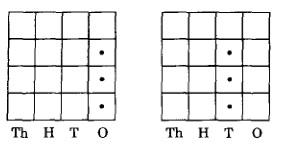
This representation reflects
(a) position of numbers on the abacus
(b) concept of place value
(c) equivalence of tens and ones
(d) mathematical game
Q50. Children at the primary stage are able to classify the given shapes based on their appearance. According to Van Hiele levels of geometry, they are at
(a) Visualization stage
(b) Analytic stage
(c) Informal deduction stage
(d) Formal deduction stage
Q51. Manipulative models, static pictures, written symbols, spoken and written language, real-world situation or contexts are five ways to represent
(a) Mathematical thinking and ideas
(6) Geometrical proof
(C) Mathematics curriculum
(d) Mathematical vocabulary
Q52. After teaching the concept of division, a teacher-created Mathematical Wall’ in the classroom and asked the students to write any two division facts in the assigned columns within 48 hours
| MATH WALL | |||
| Ankit 25 ÷ 5 = 5 | Auku 0 ÷ 6 = 0 | Babita | Bobby |
| Pragya | Dhruv | Sohan | Harsh |
| Rahul | Smita | Sunil | Tushar |
This activity can help the teacher to
(a) make the classroom environment noise-free
(b) engage the students for the next two days in some mathematical work
(c) give an opportunity of expression to every child and to learn from each other
(d) keep the record of the number of facts learned by the students
Q53. A possible indicator pertaining to visual memory barrier hampering with learner’s mathematical performance is
(a) difficulty in retaining mathematical facts and difficulty in telling time
(b) difficulty in using a number line
(c) difficulty to count on within a sequence
(d) difficulty in handling small manipulations
Q54. A teacher in Class-III distributed the following cards and asked the children to match the same shapes.
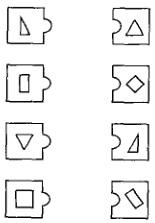
The objective of this game is to
(a) make the classroom environment engaging and joyful
(b) help children to recognize the same shapes in different orientations
(c) enhance eye-hand coordination
(d) develop the concept of similarly and congruency
Q55. Geo-Board is an effective tool to teach
(a) basic geometrical concepts like rays, lines, and angles
(b) geometrical shapes and their properties
(c) difference between 2D and 3D shapes
(d) concepts of symmetry
Q56. Proficiency in Mathematical language in the classroom can be enhanced by presenting the problem in the following Sequence.
(a) Everyday language → Mathematized situation language → Language of Mathematical problem solving → Symbolic language
(b) Symbolic language → Language of Mathematical problem-solving → Mathematized situation language → Everyday language
(c) Everyday language → Language of Mathematical problem-solving → Mathematized situation language → Symbolic language
(d) Language of Mathematical problem-solving → Mathematized situation language → Symbolic language → Everyday language
Q57. Procedural fluency in Mathematics implies knowledge of rules, formulae, or algorithms and implementing them with accuracy and flexibility, and efficiency. Flexibility in Mathematics refers to
(a) ability to solve different types of problems from the same topic
(b) ability to solve problems from arithmetic and geometry with the same efficiency
(c) ability to solve a particular Kind of problem using more than one approach
(d) ability to solve problems with accuracy, writing all steps
Q58. A child mentally calculated (27+38) as 65. When he was asked to explain his method of addition, he responded that 38 is near to 40 so (27+40) is 67, then I removed 2 to get 65. This strategy of addition is
(a) Direct modeling
(b) Regrouping
(c) Compensating
(d) Incrementing
Q59. Mental Math activities are important because they provide a chance to
(a) Developmental computation procedures as the students try to identify the relationship between numbers for fast calculations
(b) master procedures learned in class using paper-pencil
(c) master algorithms learned and practice more number problems in less time
(d) develop their speed with accuracy for calculations and help to improve performance in examinations
Q60. A child of the primary class is not able to differentiate between numbers, operation symbols, coins, and clock hands. This indicates that the child has a problem regarding
(a) Auditory memory
(b) Working memory
(c) Visual processing
(d) Language processing